In the industrial world, the importance of reliable and robust electrical connections cannot be overstated. Industrial plugs and sockets are the backbone of electrical connectivity, providing the critical link between power sources and industrial equipment. Balaji Switchgears understands this necessity and offers a wide range of high-quality industrial plugs and sockets designed to meet the diverse needs of various industrial applications.
Introduction to Industrial Plugs and Sockets
Industrial plugs and sockets differ significantly from their domestic counterparts. They are engineered to handle higher voltages and currents, withstand rough handling, resist environmental hazards, and maintain connectivity in demanding industrial environments. The design and manufacturing of these connectors follow stringent standards to ensure safety, durability, and compatibility across different systems and regions.
Types of Industrial Plugs and Sockets
The types of industrial plugs and sockets can be categorized based on several factors, including pin configuration, voltage and frequency ratings, degree of protection, and specific applications.
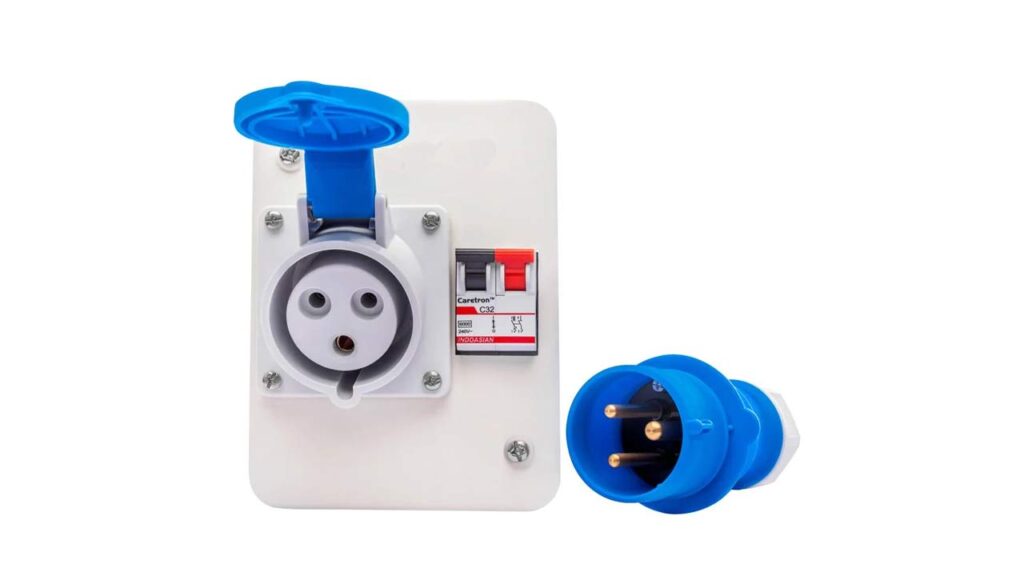
- Pin Configurations: The number of pins in an industrial connector can range from two to five or more. The configuration depends on whether the system is single-phase or three-phase, with additional pins for neutral and earth connections. Common configurations include 2P+E (two poles plus earth), 3P+E (three poles plus earth), and 3P+N+E (three poles plus neutral plus earth).
- Voltage and Frequency Ratings: Industrial connectors are designed to accommodate a wide range of voltages, typically up to 1000 V DC or AC. The current ratings can go up to 800 A for heavy-duty applications. Frequency ratings are also considered, with some connectors rated for frequencies up to 500 Hz.
- Protection Degrees: The degree of protection provided by an industrial plug or socket is indicated by its IP rating. For example, an IP44 rating signifies protection against solid objects larger than 1 mm and water splashing from all directions. An IP67 rating offers complete protection against dust ingress and temporary immersion in water.
Specifications of Industrial Plugs and Sockets
Adherence to international standards is crucial for ensuring the safety and interoperability of industrial connectors. The IEC 60309 standard is widely recognized in this regard, providing guidelines for color codes, dimensions, configurations, voltage, frequency ratings, and degrees of protection.
- Color Codes: To prevent accidental mismatches that could lead to equipment damage or safety hazards, IEC 60309 specifies color codes for different voltage ratings. For instance, blue indicates a voltage rating of up to 250 V (AC), red signifies 400 V (AC), while yellow represents 1000 V (AC or DC).
- Dimensions: The standard also defines precise dimensions for plugs and sockets to ensure a secure fit that prevents accidental disconnections.
- Configurations: The layout of pins is standardized according to IEC 60309 configurations. This uniformity ensures that plugs from one manufacturer can be used with sockets from another without compatibility issues.
Applications
Industrial plugs and sockets find applications across a broad spectrum of industries:
- Manufacturing: They power machines that perform cutting, welding, shaping, or assembly operations.
- Construction: Robust connectors are used on construction sites where they are exposed to dust, moisture, and mechanical stress.
- Hazardous Environments: In areas with explosive gases or combustible dust, specially designed connectors with higher protection ratings are employed.
Conclusion
Selecting the right type of industrial plug or socket is paramount for maintaining operational efficiency and safety standards in any industrial setting. Balaji Switchgears‘ extensive range of industrial connectors ensures that businesses can find the perfect match for their specific requirements.
For detailed product specifications or assistance in choosing the right connector for your application, reach out to us!
Originally Published at: https://balajiswitchgears.com/understanding-the-different-types-of-industrial-plugs-and-sockets/
Comments
Post a Comment